What Does 4B Mean On Driving Licence: Understanding 4B Date
You pick up your UK photocard driving licence, scan the front, and hit a field labelled “4b” next to a date you barely remember checking. Is it your issue date? Your birthday? An entitlement expiry? For most drivers, this small printed field goes unnoticed for years — until a hire desk agent declines the card, or a police officer flags it at the roadside. This guide explains exactly what the 4B field means, where to find it, what happens when it passes, and how to renew before it becomes a legal problem. By the time you finish reading, you will know how to read your entire photocard confidently.
Key Takeaways
- Field 4B on a UK driving licence is the photocard expiry date, printed on the front of the card
- 4A is the issue date; 4B is the expiry date — they always appear as a pair
- A standard photocard expires every 10 years; drivers aged 70 and over renew every 3 years
- Driving with an expired 4B photocard can result in a fine of up to £1,000 (GOV.UK)
- Your driving entitlement does not expire when 4B expires — but your physical document does
- Online renewal via GOV.UK costs £14 and takes approximately one week to process
- “Category 4B” does not exist — vehicle categories are letter-coded and listed on the back of the card
- Set a personal calendar reminder ahead of your 4B date; do not rely solely on the DVLA postal reminder
Table of Contents
What Does 4B Mean On Driving Licence?
Field 4B on a UK driving licence is the photocard expiry date. It appears on the front of the card and tells you the date by which your physical driving licence card must be renewed. This is not the date your driving entitlement expires. It is the date the card itself — the document in your wallet — becomes invalid.
Here’s the thing: this distinction matters far more than most drivers realise. Your right to drive a particular vehicle category is recorded separately on the back of the card, under the entitlement columns. The 4B date only governs the validity of the card as a document. When a hire company, employer, or police officer checks your licence, the 4B field is often the first thing they look at.
Understanding what does 4b mean on driving licence is a legal compliance issue. The DVLA’s position, as published on GOV.UK, is that you must keep your photocard up to date. Driving with an expired photocard is an offence under the Road Traffic Act 1988, regardless of whether your driving entitlement remains active.
Driving Licence 4B?
A quick note on spelling: “licence” (with a “c”) is the correct British English noun form — the document you carry. “License” (with an “s”) is the verb, meaning to authorise or permit. Both spellings appear in searches, and throughout this guide, British English is used consistently, as this topic is specific to the UK regulatory framework.
For international readers: the field numbering system on UK driving licences was inherited from EU driving licence directive standards and retained post-Brexit. If you hold a non-UK licence, your 4B field serves the same function, but renewal periods and requirements differ according to the issuing country’s rules.
{First} CTA
Lorem ipsum dolor sit amet, consectetur adipiscing elit. Ut elit tellus, luctus nec ullamcorper mattis, pulvinar dapibus leo.
What Is 4B On Driving Licence?
For first-time drivers, the number “4B” can look like a category code or a technical classification. It is neither. The numbered fields on a UK photocard driving licence are simply an administrative labelling system — a standardised way of organising printed data so that any authority across the UK can read the card consistently.
Field 4B has one job: showing the date your photocard expires. A common misunderstanding is that the card renews automatically, or that a reminder guarantees timely action. The DVLA sends a D798 renewal reminder approximately 90 days before your 4B date — but renewal is your legal responsibility, and reminder letters can be missed after a change of address.
Driving Licence 4B Meaning?
The 4B meaning on a driving licence is straightforward: this card is valid until this date. The format is DD MM YYYY, printed on the front of the photocard alongside fields 4A (issue date) and 4C (issuing authority, shown as “DVLA”).
| Field | Label | What It Shows |
|---|---|---|
| 4A | Issue Date | Date the current card was printed and issued |
| 4B | Expiry Date | Date the current card expires and must be renewed |
| 4C | Issuing Authority | Always reads “DVLA” on a UK licence |
| 5 | Licence Number | Your unique DVLA driver reference number |
The 4B field carries more weight than drivers typically expect. A current, valid photocard is required for vehicle hire, certain employment identity checks, and as proof of driving status at the roadside. Treating the 4B date with the same urgency you would apply to a passport expiry is the right approach.
[Expert Quote Placeholder: Road traffic solicitor on the legal consequences of an expired 4B date — particularly in relation to insurance claim validity]
4B Date On Driving Licence?
The 4B date is set at the time of issue and applies to the physical card — not to your entitlement to drive. For the majority of UK drivers, a standard photocard licence is valid for ten years. Two exceptions alter this cycle:
Drivers aged 70 and over: Once you reach 70, your licence must be renewed every three years. This is a medical fitness declaration requirement, not a penalty — and renewal at this stage is free of charge according to GOV.UK.
Medically restricted licences: If you hold a licence subject to a medical condition review, the DVLA may issue a card with a validity period shorter than ten years, sometimes as little as one, two, or three years.
The date format is day, month, year — so 04 09 2031 means the card expires on 4 September 2031. Some drivers read this incorrectly by reversing the month and day, particularly those accustomed to American date formatting. If your date looks unusual, verify by counting forward ten years from when you last renewed.
The DVLA issues a D798 reminder form approximately 90 days before the expiry date. If you have moved and not updated your address on your licence, that form goes to your old address. This is one of the most frequent reasons drivers unknowingly pass their 4B date without acting.
{2nd} CTA
Lorem ipsum dolor sit amet, consectetur adipiscing elit. Ut elit tellus, luctus nec ullamcorper mattis, pulvinar dapibus leo.
Driving Licence 4B Meaning?
Beyond the simple definition, it helps to understand the official framework behind the 4B field. The DVLA operates under the Road Traffic Act 1988 and the Motor Vehicles (Driving Licences) Regulations 1999, which set out the requirement for drivers to hold a current, valid photocard. GOV.UK states that it is a criminal offence to drive without a valid driving licence document.
A significant source of confusion is the difference between photocard validity and entitlement validity. When your 4B date expires, your photocard is no longer valid as a document — but your driving entitlement (your right to drive specific vehicle categories) is recorded separately and does not automatically lapse at the same moment. This creates an in-between state: you are still theoretically entitled to drive, but you are carrying an expired identity document.
There is also a persistent myth about “lifetime licences.” Before photocards were introduced in 1998, paper licences in the UK had no expiry date and were sometimes described informally as lifetime documents. Photocards replaced this system entirely. If you hold an old paper licence, it is now invalid as a driving document and must be exchanged for a photocard.
[Internal Link: “how to exchange an old paper driving licence for a UK photocard” -> DVLA Photocard Exchange Guide]
What Is The Field 4B On A Driving Licence?
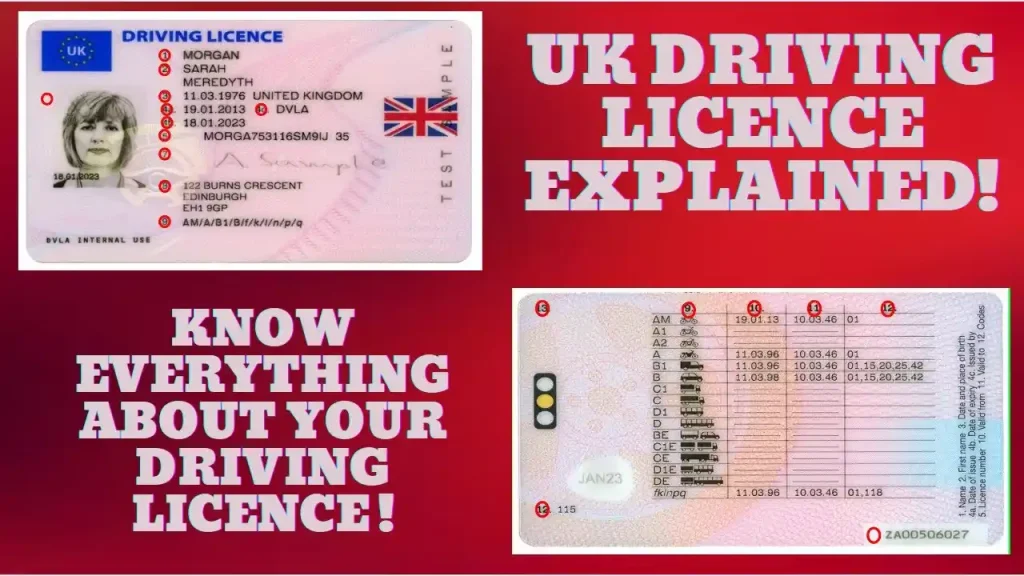
The field numbering system on UK driving licences is standardised. Fields are numbered sequentially across both faces of the card. The front carries fields 1 through 5 and field 8. The back carries fields 9 through 12, which list your vehicle entitlement categories and their corresponding validity dates.
Field 4 is divided into three subfields:
- 4A — the date this particular card was issued
- 4B — the date this particular card expires
- 4C — the issuing authority, printed as “DVLA”
This is why 4A and 4B always appear together on the front of the card — they record the full lifecycle of that specific physical document.
One practical scenario worth understanding: if you update your address, the DVLA issues a replacement photocard. That new card carries a new 4A date reflecting the reissue. However, the 4B date on the replacement card typically matches your original expiry — your renewal clock does not restart because of an address change. The exception is if you are already within the renewal window, in which case the DVLA may issue a fresh ten-year term.
Image Suggestion: Annotated diagram of a UK driving licence front face with fields 4A, 4B, and 4C clearly labelled | Alt Text: UK driving licence front with fields 4A issue date and 4B expiry date labelled
Where Is The Expiry Date On A UK Driving Licence?
The expiry date — the 4B field — is on the front of the photocard, in the lower section beneath your photograph, name, and date of birth. It sits in a horizontal row alongside 4A and 4C, labelled “4b” in small print immediately before the date itself.
On most current UK photocards, the layout from left to right in that row reads: issue date (4a), expiry date (4b), issuing authority (4c). The text is small, and on older cards, the print contrast can make it harder to read in low light. If you are checking your own licence, tilt the card slightly under a lamp — the embossed security features should not obscure the date fields.
This placement matters in real-world situations. When you hand your licence to a hire car agent, they typically flip it face-up, locate the 4B date immediately, and check it against today’s date before doing anything else. Knowing where the field is means you can pre-check before arrival and avoid avoidable delays.
{3rd} CTA
Lorem ipsum dolor sit amet, consectetur adipiscing elit. Ut elit tellus, luctus nec ullamcorper mattis, pulvinar dapibus leo.
Where Is Expiry Date On Driving Licence?
The expiry date is always on the front, not the back. This is a common point of confusion because the back of the card contains a series of dates next to each vehicle category code — for example, the date you passed your test for category B, or the date a particular entitlement expires. These are entitlement dates, not photocard expiry dates.
So what does this look like in practice? Imagine scanning the back of your card and seeing a date of 2025 next to category B. This is the validity date for that entitlement on the card — it does not mean your photocard expires in 2025. Your photocard expiry is always the 4B date on the front.
Drivers often overlook the 4B field because, for the majority of their driving life, it simply does not come up. You renew once a decade, receive the new card, file it away, and carry on. The risk comes when that decade passes quietly. Setting a calendar reminder eighteen months before your 4B date gives you more than enough time to renew without pressure.
Driving Licence 4A 4B?
Fields 4A and 4B always appear as a pair. Together they define the exact lifespan of your current photocard document.
| Field | What It Shows | Typical Example |
|---|---|---|
| 4A (Issue Date) | When this card was printed and sent to you | 14 03 2019 |
| 4B (Expiry Date) | When this card must be renewed by | 14 03 2029 |
For a standard licence holder, the gap between 4A and 4B is exactly ten years. For drivers aged 70 and over, it is three years. For medically restricted licences, it may be shorter.
The real question is: what happens to 4A and 4B when your personal details change? If you reissue your card due to an address or name change, the new card carries a new 4A date — but your 4B date remains tied to your original renewal cycle. This catches some drivers off guard. They receive a fresh-looking card with a recent 4A date and assume they have ten full years again. Check your 4B date every time you receive a new card, regardless of why it was issued.
[Internal Link: “what to do when your driving licence details change” -> DVLA Personal Details Update Guide]
UK Driving Licence 4B?
The UK regulatory framework is unambiguous about the 4B field. Under the Motor Vehicles (Driving Licences) Regulations 1999, drivers are required to hold a valid, current photocard. The DVLA enforces this requirement and the penalties for non-compliance are published on GOV.UK.
If your 4B date has passed, the consequences can include:
- A fine of up to £1,000 for driving without a valid driving licence document (GOV.UK)
- Complications with motor insurance — some insurers treat an expired photocard as grounds to contest a claim
- Outright refusal of vehicle hire, as rental companies routinely verify the 4B date before handing over keys
Need to renew your photocard quickly and without the hassle? Our DVLA renewal assistance service guides you through every document requirement, checks your application for common errors before submission, and provides step-by-step support from start to finish. Whether you are renewing a standard photocard or managing a more complex situation such as a medical licence review, we handle the detail so you can focus on driving.
Driving Licence 4B Renewal?
Renewal becomes necessary as soon as your 4B date expires — or ideally, before it does. The DVLA offers three methods:
Online via GOV.UK: The fastest option. You will need a valid UK passport for the photo verification check. Standard processing takes approximately one week. The fee is £14 (GOV.UK confirmed). Renewal is free for drivers aged 70 and over, and for drivers renewing due to a medical condition.
By post using form D1: Available from Post Office branches. Processing takes up to three weeks. The same £14 fee applies for standard renewals.
At a Post Office counter: Some larger branches offer assisted counter service for the D1 postal application.
To complete the online application, you will need your current photocard driving licence (or your driver number if the card is lost), a valid UK passport for the digital photo check, your National Insurance number, and a debit or credit card for the £14 fee.
Your driving entitlement categories are automatically carried over to your new card. You do not sit another test. The new card arrives with a fresh 4A date and a new 4B date set ten years from the issue of the replacement — or three years if you are 70 or over.
Can I Drive If 4B Is Expired?
Technically, no. Once your 4B date has passed, your photocard is an expired document. You are not carrying a valid driving licence, even if your underlying entitlement to drive remains active.
The real question is about the gap between entitlement and documentation. Your driving entitlement — your legal right to drive a category B vehicle, for example — does not disappear the moment your photocard expires. But you are required by law to carry a valid licence document when driving. An expired card fails that requirement.
What to do if your 4B date has already passed:
- Do not drive until you have applied for renewal
- Apply online at GOV.UK immediately — processing takes approximately one week
- Keep your application confirmation number as evidence of submission
- Contact the DVLA directly if your new card has not arrived within two weeks
The limited exception applies if you have already submitted a valid renewal application and are awaiting your new card. In this transitional period, the DVLA may confirm your application is in progress if you are stopped. However, this is not a guaranteed legal defence — seek qualified advice if you are uncertain about your situation.
[Case Study Placeholder: A driver who discovered their 4B had expired at a hire desk, the steps taken to resolve it, and what they would do differently — illustrating both the risk and the resolution path]
What Is Category 4B On A UK Driving Licence?
There is no “Category 4B” in UK driving licence entitlement codes. This is one of the most common misreadings of the card, and it is worth correcting directly.
Vehicle entitlement categories on a UK driving licence use letter-based codes. Category B is a standard car. Category BE is a car with a trailer. Category C1 is a medium-sized lorry. Category D1 is a minibus. These are listed on the back of the card alongside the date you became entitled to each category and, for some, a validity end date.
When someone searches “category 4B on driving licence,” they almost always mean field 4B — the expiry date on the front. If you are trying to verify what vehicles you are permitted to drive, look at the entitlement table on the reverse of your card, not the numbered fields on the front.
Frequently Asked Questions About What Does 4B Mean On Driving Licence
What Does 4B Mean On Driving Licence In The UK And Why Is It Important?
Field 4B on a UK driving licence is the expiry date of your photocard. It is important because once this date passes, your physical licence document is no longer valid. Under the Road Traffic Act 1988, you are required to carry a current driving licence when driving. Failing to do so can result in a fine of up to £1,000 and may complicate any motor insurance claim made while driving on an expired card. Your driving entitlement may still be active — but without a valid card, you are not in legal compliance.
What Is The Difference Between 4A And 4B On A UK Driving Licence?
Field 4A is the issue date — the date your current photocard was printed and dispatched by the DVLA. Field 4B is the expiry date — the date by which you must renew the card. For standard licence holders, these dates are ten years apart. For drivers aged 70 and over, they are three years apart. When you reissue your card due to a personal detail change such as a new address, the 4A date updates to the reissue date, but the 4B date stays the same unless you are already in the renewal window.