

Passed Driving Test What Are Your Next Essential Steps?
So you have finally done it. After months of lessons, nerves, and practice, you have passed your driving test. You have the paper slip in your hand, your examiner is smiling, and the road ahead feels open for the very first time. But now what? The moment you leave the test centre, you step into a world of new responsibilities, and understanding exactly what those are will help you transition smoothly from learner driver to fully qualified motorist.
This guide walks you through everything you need to know after passing your practical driving test. From understanding your pass certificate to knowing exactly what you can and cannot do behind the wheel, we cover the essential steps so you feel confident and legally compliant from day one.


Key Takeaways
- You can legally drive immediately after passing your test, but you must follow specific documentation rules
- Your provisional licence will be retained at the test centre, and your full licence will arrive by post
- Insurance must be updated before you drive, as provisional coverage is no longer valid
- P plates are recommended but not legally required in England and Wales (mandatory in Northern Ireland for one year)
- Motorway driving requires additional training through an approved instructor before you can drive solo on high-speed roads
- A post-test training course can significantly reduce your insurance premiums and build genuine confidence
Table of Contents
Passed Driving Test
Passing your driving test represents one of the most significant milestones in your life. It marks the transition from someone who learns under supervision to a driver who bears full responsibility for their actions on the road. The achievement deserves recognition, and you should take a moment to acknowledge the months of effort, early mornings, and challenging situations that brought you to this point.
The practical driving test evaluates your ability to drive safely and independently in various road and traffic conditions. Passing demonstrates that you have reached the minimum standard required by the Driver and Vehicle Licensing Agency to operate a vehicle on public roads without supervision. This standard exists to protect you, your passengers, and other road users.
According to DVSA data, learners take an average of 45 hours of professional training plus 22 hours of private practice before passing. This context helps readers understand what a normal preparation journey looks like.
Can You Drive Straight After Passing Your Test?
Yes, you can drive immediately after you pass your test, but there are important conditions you must meet. The moment your examiner announces you have passed, you are legally entitled to drive on UK roads without supervision. This entitlement is real and immediate.
When you pass, the test centre will give you a pass certificate, also known as a D778. This document serves as temporary proof of your driving qualification until your full licence arrives. It contains your test details, candidate reference number, and information confirming your successful completion of the practical assessment.
The examiner will keep your provisional licence photocard and paper counterpart, and the DVLA will automatically begin processing your full driving licence. You can drive using your pass certificate while waiting for your photocard licence to arrive through the post.
Important: While you can drive, you must ensure your insurance covers you as a fully qualified driver before getting behind the wheel. This point is critical and often overlooked by excited new drivers.
What To Do When You Pass Your Driving Test?
After passing your driving test, take a moment to collect yourself before leaving the test centre car park. Driving requires full concentration, and the emotions of passing can be distracting. Once you feel composed, follow this checklist of immediate actions.
At the test centre:
- Collect your pass certificate (D778) from the examiner
- Verify that all details printed on the certificate are correct, including your name and date of birth
- Confirm that the examiner has retained your provisional licence photocard
- Ask any questions about the certificate before leaving if anything is unclear
Before driving away:
- Notify your insurance provider of your new status as a qualified driver
- Update any driving apps or services that track your learner status
- Store your pass certificate somewhere safe but accessible for your vehicle
- Consider your route home carefully, choosing quieter roads if possible
Keep your pass certificate in the glove box of your car rather than at home. You never know when you might need to prove your entitlement, and having it in the vehicle ensures you are always prepared.
Passed Your Test But Insured To Drive?
You can drive immediately after passing, but only if your cover has been updated for full licence status. Avoid invalid learner-only cover before your first solo trip.

What Is A Practical Driving Test Pass Certificate?
The practical driving test pass certificate, officially designated as form D778, is a physical document issued by the Driver and Vehicle Licensing Agency through the test centre examiner. It functions as temporary proof that you have passed your practical driving test and holds a valid full driving licence entitlement.
The certificate contains several key pieces of information printed directly on the document. Your name appears exactly as it does on your provisional licence. Your date of birth confirms your identity. Your candidate reference number allows the DVLA to locate your records quickly. The test date and result are recorded, along with the category of vehicle you passed your test for.
This certificate remains valid for two years from the date of your test. If your full licence photocard does not arrive within this period, you would need to contact the DVLA directly. However, most licences arrive well within two to three weeks of passing your test.
What Happens If You Lost Your Practical Driving Test Pass Certificate?
Losing your pass certificate before your full licence arrives does not mean you lose your driving entitlement. The DVLA maintains electronic records of all test results, and there are ways to verify your status without the physical document.
Contact the DVLA directly if you lose your certificate. You can reach them by phone or through their online services portal. You will need to provide identifying information, including your full name, date of birth, and possibly your National Insurance number, to access your records.
Use the DVLA online check service to verify your entitlements. By logging into the government website with your verified credentials, you can view your driving record and confirm that your full licence is being processed. This electronic record serves as verification of your passed test even without the paper certificate.
Contact your driving instructor if you used one. They may have a copy of your test booking confirmation or other records that could help verify your result while you wait for your licence to arrive.
Buyer Beware: Be cautious of websites that offer to “retrieve” your pass certificate for a fee. The DVLA provides this service for free, and any site charging for this service is likely a scam targeting vulnerable new drivers.
How Long Does It Take To Get Your Driving Licence After Passing?
The standard timeframe for receiving your full driving licence photocard through the post is approximately three weeks from the date of your test. This period allows the DVLA to process your new entitlement, update their records, and dispatch your new photocard to the address registered on your provisional licence.
Delivery is handled by Royal Mail, and the photocard typically arrives in a welcome pack containing your new driving licence and a summary of your entitlements. The package will be posted to the address you provided when you applied for your provisional licence, so ensuring this address is current before your test is important.
If your licence does not arrive within three weeks, check your address is correct on the DVLA website. If the address is correct and your licence has not arrived after four weeks, contact the DVLA directly to query the progress of your application. You should have your pass certificate and candidate reference number ready when you call.
If you have recently moved, update your address with the DVLA before your test if possible. If you discover an incorrect address after passing, contact the DVLA immediately to avoid your licence being sent to the wrong location.
Timeline Reference:
| Action | Timeframe |
|---|---|
| Pass your test | Day 0 |
| Receive pass certificate | Same day |
| DVLA processes your licence | 1-7 days |
| Full photocard arrives | Up to 3 weeks |
Join Drivers Building Confidence After Passing
New drivers often benefit from advanced practical sessions and assessed drives with an instructor. Get structured coaching that helps you handle real-world roads with more confidence.

Can You Drive Before Your New Licence Arrives?
Yes, you can legally drive before your full licence photocard arrives, provided you meet specific conditions. Your pass certificate grants you driving entitlement during this interim period, effectively giving you the same legal status as a full licence holder for up to two years or until your photocard arrives, whichever happens first.
During this waiting period, you must drive in accordance with full licence rules, not provisional licence rules. This means you can drive on motorways (after completing appropriate training), you do not need a supervising driver, and you are subject to standard speed limits and road rules rather than learner restrictions.
However, you cannot drive if your insurance does not cover you. This point is critical. Many learners have insurance policies that specifically cover provisional licence holders with supervision requirements. These policies typically become void or change significantly the moment you pass your test. Contact your insurer before driving to confirm your coverage status.
Buyers Beware: Insurance policies that appear cheap for learners often contain clauses that make them invalid for newly qualified drivers. Always read the small print and confirm your coverage status before driving.
What Should You Carry If You Want To Drive While Waiting?
When driving after passing your test but before your photocard arrives, you must carry specific documentation to prove your legal entitlement if asked by police or other authorities. The items you carry may vary depending on your specific situation.
Essential items to carry:
- Your pass certificate (D778) as primary proof of your passed test
- Your provisional licence photocard (in some cases, the examiner may have retained this)
- Insurance documentation confirming valid cover for qualified drivers
- Your driving test booking confirmation or any correspondence from the DVLA about your application
Digital alternatives:
The DVLA and police forces recognise that electronic records exist. If you have access to your DVLA driving record through the official portal, you can show your electronic licence status on a smartphone or tablet device. However, carrying the physical pass certificate is strongly recommended as the most reliable form of documentation.
What Are The Rules For P Plates On Your Car?
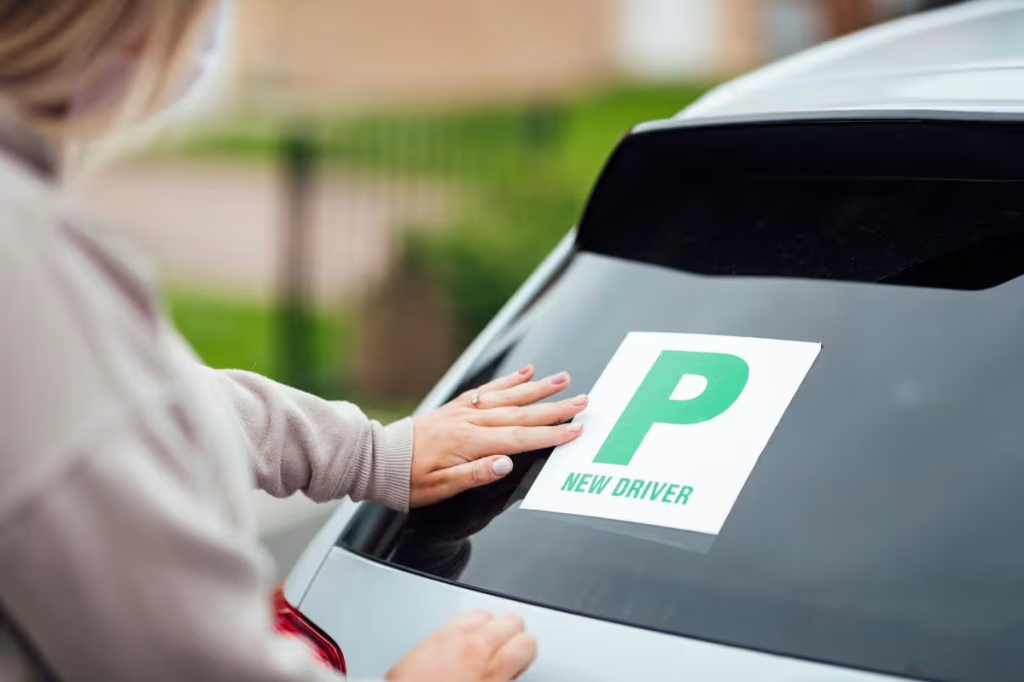
P plates, also known as probationary plates, are green displayed markers that indicate a driver has recently passed their driving test. The letter P stands for “probationary,” reflecting the two-year period following a pass during which new drivers build experience and face higher consequences for certain driving offences.
In England and Wales, P plates are entirely voluntary. There is no legal requirement to display them, and you cannot be fined for failing to use them. Many newly qualified drivers choose to display P plates because they signal to other road users that the driver may be less experienced, which can encourage patience and understanding from other drivers.
In Northern Ireland, P plates are mandatory for the first year after passing your test. Drivers who fail to display P plates during this period can face penalties.
In Scotland, P plates follow the same voluntary status as England and Wales.
The purpose of P plates extends beyond courtesy signalling. Insurance providers often recognise P plate users as more responsible drivers, which may positively influence premium pricing. Additionally, driving with P plates can help you identify areas where you might need more practice, as you may feel more aware of situations requiring additional caution.
P Plates UK Regional Requirements:
| Region | P Plate Requirement | Duration | Penalty for Non-Display |
|---|---|---|---|
| England | Voluntary | N/A | None |
| Wales | Voluntary | N/A | None |
| Scotland | Voluntary | N/A | None |
| Northern Ireland | Mandatory | 1 year | Fine possible |
Get The Post-Test Driver Checklist Today
Keep the essential next steps in one place, from collecting your D778 pass certificate to updating insurance and planning your route home. Stay organised from day one.
How Long After Passing Your Driving Test Can You Drive On A Motorway?
After passing your standard practical driving test, you are not automatically permitted to drive on motorways alone. This restriction exists because standard driving test routes do not include motorway driving, and the high-speed, multi-lane environment of motorways requires specific skills and confidence that the basic test does not assess.
The current rule states that new drivers who passed their test before 2018 cannot drive on motorways at all as solo drivers unless they complete an additional motorway training course. Drivers who passed from 2018 onwards can drive on motorways as solo drivers because motorway driving was added to the practical test syllabus in December 2017.
Regardless of when you passed, completing a motorway training course is strongly recommended. These courses, offered by approved driving instructors, provide essential experience in high-speed driving, lane changing, joining and leaving motorways, and dealing with unexpected situations that only occur on motorways.
Motorway Training Options Comparison:
| Course Type | Duration | Content | Cost Range | Certification |
|---|---|---|---|---|
| Pass Plus | 6 hours | Motorways, night driving, varied conditions | £100-200 | Certificate may reduce insurance |
| Motorway Training | 2-3 hours | Motorway specific skills only | £80-150 | Statement of completion |
| Refresher Course | Varies | Tailored to your needs | £40-80 per hour | No formal certification |
Tips for building motorway confidence:
- Book a motorway training course with an approved driving instructor before attempting solo motorway driving
- Start with shorter journeys during quieter periods
- Practice joining and leaving motorways multiple times before tackling longer distances
- Build your confidence gradually rather than rushing into long motorway journeys
Do They Take Your Provisional Licence When You Pass?
Yes, the examiner will retain your provisional licence photocard at the test centre when you pass. This is standard procedure and forms part of the administrative process for upgrading your licence status.
The retained photocard is sent to the DVLA as part of the notification process. Your provisional licence records are updated in the central database to reflect your new full entitlement. The DVLA then uses this information to generate and post your new full driving licence photocard.
This process is automatic and does not require any action from you beyond confirming your registered address is correct. You do not need to apply separately for your full licence or complete additional forms at the test centre.
Can You Keep Your Provisional Licence After Passing?
Generally, no. The DVLA retains your provisional photocard and destroys the counterpart as part of the licence upgrade process. You do not have the option to keep your provisional licence as a keepsake or backup document.
However, there are specific circumstances where you might need to retain your provisional licence records:
- If you passed your test in a category that does not automatically upgrade all entitlements (for example, passing a specific vehicle category that does not include automatic entitlement to all related categories)
- If you are upgrading from an older paper licence format and need to maintain records of previous entitlements
- If your address has changed and you need to coordinate with the DVLA to ensure your full licence arrives at the correct location
In these cases, contact the DVLA directly to discuss your specific situation before your test if possible, or immediately after if you discover an issue with your licence processing.
How Do You Find Out From The DVLA When You Passed Your Driving Test?
The DVLA maintains comprehensive records of all driving test results, and you can access your driving record online through the official government portal. This service allows you to verify your entitlements, check your test history, and confirm the status of any licence applications.
To access your DVLA driving record:
- Visit the official DVLA website (gov.uk/check-driving-licence)
- Create or log into your government gateway account
- Provide your driving licence number, National Insurance number, and postcode
- View your current entitlements and any recent updates
This service is particularly useful if you need to prove your driving status to employers, rental companies, or other organisations before your physical licence arrives. The electronic record maintained by the DVLA holds the same legal weight as your physical documentation in most circumstances.
Real Reader Journey: Sarah passed her test on a Monday morning. By that afternoon, she needed to rent a car for a work trip. Without her physical licence in hand, she used the DVLA online service to prove her entitlement and successfully rented the vehicle. This is just one example of how the electronic system can help newly qualified drivers navigate real-world situations.
Do You Need To Update Your Insurance Policy Immediately?
Yes, updating your insurance is one of the most urgent actions you must take after passing your driving test. Your provisional licence insurance policy typically covers you only while you hold a provisional licence and meet specific conditions, including supervision requirements and adherence to L plate display rules.
The moment you pass your test, these conditions change fundamentally. You are no longer a learner driver, you do not need supervision, and you are no longer bound by provisional licence restrictions. Your existing insurance policy may no longer cover you because the policy terms assumed you were a learner.
Insurance Cost Factors for New Drivers:
| Factor | Impact on Premium | Mitigation Strategy |
|---|---|---|
| Age under 25 | Increases cost significantly | Add older driver as named driver, complete Pass Plus |
| Car engine size | Larger engines cost more | Choose lower power vehicle initially |
| Location | High crime areas increase cost | Install security devices, park in garage |
| Annual mileage | Higher mileage increases risk | Estimate accurately, do not underestimate |
| Occupation | Some jobs considered higher risk | Compare providers, some offer professional discounts |
What to do:
- Contact your insurance provider immediately after passing your test
- Inform them of your new status as a qualified driver
- Request a quote for full licence cover or ask them to update your existing policy
- Compare quotes from multiple providers to ensure you are getting the best rate
Newly qualified drivers often face higher insurance premiums than experienced drivers because insurers view them as higher risk. However, completing additional courses, maintaining a clean record, and comparing multiple providers can help reduce costs significantly.
We offer bespoke insurance policies designed specifically for newly qualified drivers. Our policies are tailored to your situation, offering competitive rates and flexible coverage options. Use our online coverage tool to secure an immediate, cost-effective quote that meets your needs as a new driver.
How Should You Prepare For Your First Drive After Passing?
Your first drive as a qualified driver will feel different from every drive you have taken before. For the first time, there is no instructor or supervising driver beside you. The decisions are entirely yours, and the responsibility is entirely yours. This transition deserves careful preparation.
Plan your route carefully. Choose roads you know well, avoid complex junctions or high-traffic areas for your first journey, and stick to quieter times of day. Sunday mornings and early weekday mornings typically offer lighter traffic and more forgiving driving conditions.
Remove distractions before you start driving. Put your phone in a bag or the glove compartment, set your music before you begin, and make sure any passengers understand that you need to concentrate. Driving without an instructor beside you requires full attention, and removing potential distractions helps you stay focused.
Stay calm and manage pressure. It is normal to feel nervous during your first independent drive. Take deep breaths, drive at a speed you feel comfortable with, and remember that other drivers will understand you are new. If you feel overwhelmed, pull over in a safe place and take a moment to compose yourself.
Consider booking an assessed drive with your instructor. Many instructors offer post-test assessed drives where they sit beside you as you drive, providing feedback and identifying areas where you might benefit from additional practice. These sessions can build genuine confidence and help you identify bad habits before they become ingrained.
We offer advanced practical driving sessions and coaching courses designed specifically for newly qualified drivers. Our instructors help you build real-world confidence through structured coaching that addresses the specific challenges new drivers face. Book your first confidence-building lesson with us today and take the next step in your driving journey.
Frequently Asked Questions About Passed Driving Test
What Happens Once You Have Passed Driving Test In The UK?
Once you pass your driving test in the UK, the examiner retains your provisional licence photocard, and the DVLA begins processing your full driving licence. You receive a pass certificate that serves as temporary proof of your entitlement. You can drive legally immediately after passing, provided you have valid insurance. Your full photocard licence arrives by post within approximately three weeks. You should update your insurance immediately, and you may display P plates voluntarily (mandatory in Northern Ireland for one year) to signal your newly qualified status.
Are P Plates Compulsory For New Drivers?
P plates are not compulsory in England, Wales, or Scotland, where they remain voluntary. However, in Northern Ireland, P plates are mandatory for the first year after passing your test. Failing to display P plates in Northern Ireland during this period can result in penalties. Even where they are not required, P plates offer meaningful benefits by signalling your new driver status to other road users and may positively influence your insurance premiums.
